
School Days in Gaza
War has damaged or destroyed over 97% of Gaza's schools; over two years of conflict has interrupted formal education for hundreds of thousands of children. A recent estimate put this number at approximately 670,000. However, a number of educational tents are being used in the Gaza Strip as temporary school facilities for children whose regular schools were destroyed and these makeshift learning centers offer basic lessons amidst continuing danger, instability, and trauma. These tents, often positioned near conflict zones like the "yellow line," serve as critical, albeit precarious, spaces for education for thousands of displaced children, with organizations including UNICEF involved in supporting these efforts.
In early January, reports by the BBC https://www.bbc.com/news/articles/c62vmn30j3yo and Al Jazeera https://www.aljazeera.com/news/2026/1/6/gaza-children-risk-snipers-to-attend-tent-schools confirmed the tragic news that virtually no educational materials have been allowed into the Gaza Strip since the beginning of the war in October 2023, with dedicated teachers making the best of basic items such as blackboards and chalk. During my recent conversation with teacher Ekhlas Sider, who oversees the daily school experience of some three hundred children that attend one of these schools (referred to by her as The Education Tent), I was reminded that creativity is often used in responding to this challenge. The Education Tent is the first educational tent established in the Gaza Strip since the start of the war to continue education after schools were bombed and a large number of schools were converted into shelters for families. The school program itself began when this remarkable teacher was displaced from the north to the south and was motivated by the desire to educate her own children as well as the children of other displaced people. With the repeated displacement from one city to another, the school moved locations several times. Despite many dangers, including exposure to gunfire, the school has survived and even thrived.
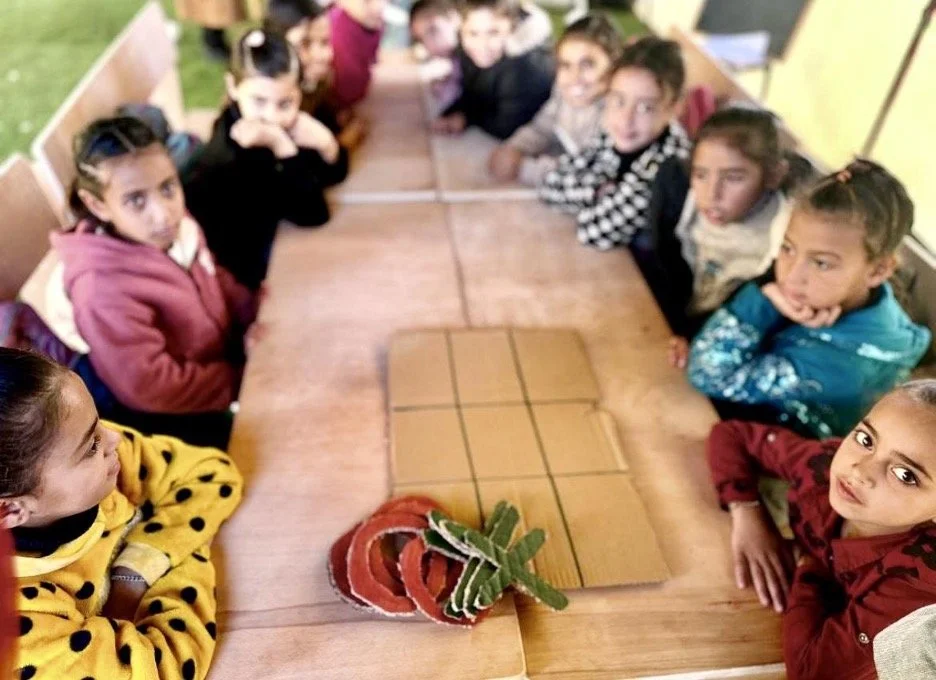
Above: Evidence of the X's and O's game, or tic-tac-toe, and other similar 3x3 grid games has been found in Egypt, dating back to around the year 1300 BC. In modern day Gaza, homemade materials encourage young students to consider the concept of strategic thinking. Photo credit: Ekhlas Sider
As is typical in such a facility, the community reflects a mixed-age grouping, covering grades 1,2 and 3. Boys and girls are both welcome in this space. Not only is traditional education valued here, but the needs of the whole child are considered; one of the daily rituals includes a pledge to practice happiness, to which both the teachers and the students commit. Academic instruction is also complemented with opportunities for physical movement and artistic expression.
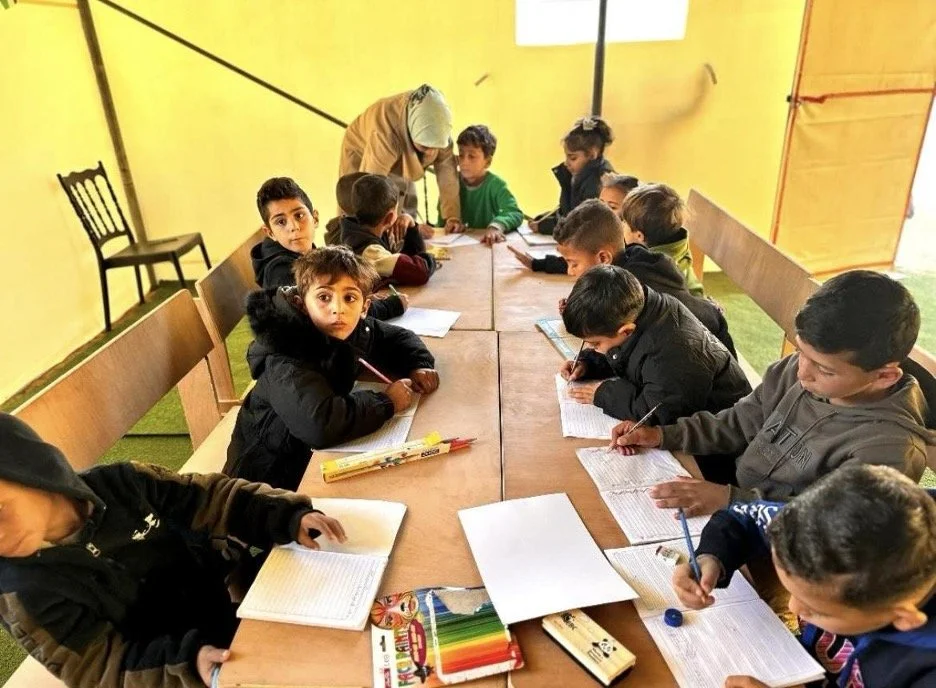
Above: The Education Tent works to provide a balance of academic instruction and cultural or sports-related experiences. Photo credit: Ekhlas Sider
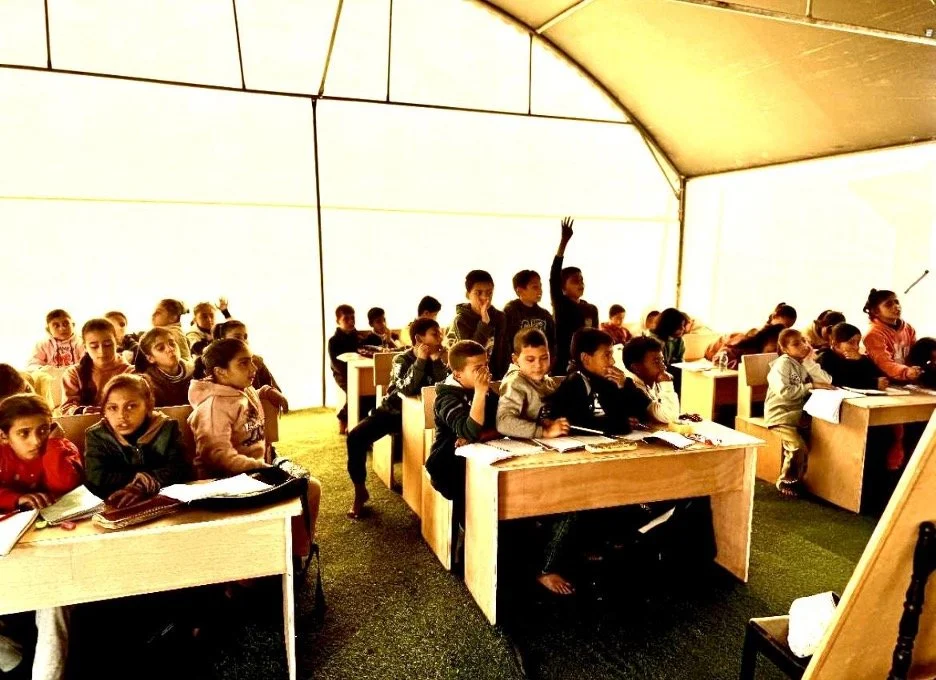
Above: This particular learning space welcomes both boys and girls. Other temporary schools might opt to offer options for single gender classrooms. For practical purposes, the huge demand for education necessitates that children attend in shifts, with many schools providing three classroom shifts per day. Photo credit: Ekhlas Sider
Besides the challenge of operating without many basic educational materials, there are additional considerations such as the lack of internet or even electricity. Nonetheless, educators like the one I spoke with are determined and optimistic about providing the best they can offer. It is of fundamental importance, for example, that each child feels seen and appreciated. Take a look at the photo below, in which six year-old Muhammad Musbah is shown, proudly holding his “identity card.”
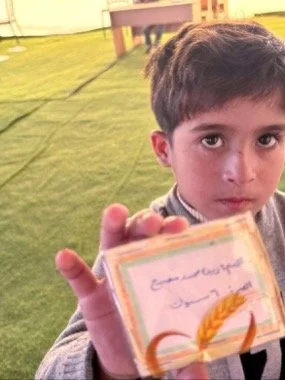
Photo credit: Ekhlas Sider
The card is modelled after the words of the Palestinian poet Mahmoud Darwish, who says at the beginning of his poem Put it on record, I am an Arab, and my ID number is fifty thousand.
For the students of The Education Tent, the cards serve as “a symbol of existence and a reminder that the children of Gaza are alive, and not just a statistic”, says the school’s administrator. My sincere thanks to her for taking the time to share her insights with me for this article. You can learn more about her school via Instagram @ekhlas_sideer